The Halfway House on Heart’s Content Barrens
by Barry Rodgers
Acknowledgements
This essay likely would not have been possible without having the prior deep efforts of Heart’s Content’s Melvin and Ted Rowe, Carbonear’s Bert Parsons, and Victoria’s Frank Clarke upon which to build. Then there were numerous other contributors from various communities ranging from Upper Island Cove to Hant’s Harbour, all too numerous to mention here by name, but non-the-less immensely appreciated. Bobby Balsom of Heart’s Content’s Mizzen Heritage Society must be the exception. Thank you, all!
The Halfway House on Heart’s Content barrens is legendary, particularly if one hales from the Heart’s Content / New Perlican area of Trinity Bay, or even from Victoria / Carbonear on the other side. Holding it to be legendary, at least very interesting, is perhaps especially natural for me as I witnessed many related stories directly from and by my mother and father, who were caretakers there, and from the mother (Jean (Legge) George) of some of my friends who, like my brother, Frank, also lived there with her parents. I wish I would have listened more attentively.
Historical Context: In 19th and early 20th-century Newfoundland, "halfway houses" were literal inns or rest stations built along grueling, isolated walking trails or early roads (such as the famed Heart's Content Halfway House). They provided shelter, food, and communication points for travelers moving between remote outports.1 Another important and often forgotten role of these houses was their usefulness in facilitating mail delivery, particularly to remote communities. The Government of Newfoundland operated at least five (5) of these houses, or hospices, on the Avalon Peninsula, from Heart’s Content to Burin: Salmonier, Heart’s Content to Carbonear, Trinity to Catalina, Renews to Trepassey, and New Harbour to Burin. 2
Location: The halfway house on the Heart’s Content barrens was located at about 47o 48’ 17” North latitude. The elevation of the open barrens as one approaches from the north west, approximates 225 meters (750 feet), with surrounding peaks reaching over 275 meters (900 feet). At this latitude and elevation, one might expect a 2o – 5o temperature drop from that at sea level, even before accounting for wind. Over the fall, winter, and early spring seasons, this is enough to turn rain at Heart’s Content to freezing rain, wet snow, and snow on the barrens and generally along the route toward Victoria. The terrain is described as an ‘exposed, rugged, and windy upland barrens prone to rapid visibility changes and drifting snow during the winter months’.3 The exposed terrain on all sides can bring high winds, blizzard, and white-out conditions.
The Barrens: Describing the reputation of “The Barrens” in recent times and the need to afford them the utmost respect, Lisa Wilson put it quite well:
After visiting Heart’s Content and getting ready to head back to town, locals always remind me to, “Be careful on the Barrens!” The Heart’s Content Barrens hold a narrow stretch of road that lies on a stark landscape, exposed on all sides. Despite its possible dangers, this road is an important throughway that links Heart’s Content and Carbonear. The Barrens are a place where you wouldn’t want to get stranded for any length of time, particularly in a blizzard, or in the cold of night.4
I can personally say that myself and Ron Rowe spent one such night. This was after the halfway house was no longer there. By this time though, c 1972, the road was upgraded and paved. Luckily there were other small private cabins in which to find shelter, which we did, in Tom Powell’s cabin. Our storm was so fierce as we passed where the halfway house had once stood, that we had trouble seeing the lines on the pavement marking the middle of the road as we trudged along, bent over against the howling wind and blinding snow. It was a beautiful star-lit night when we left Carbonear a couple of hours earlier.
It is no harm to say that a day on The Barrens can go from bright sunshine with a cloudless sky or night with the entire milky way overhead to dense fog, rain, wet snow, snow, and whiteout blizzard conditions in just a brief few hours, with fog, drizzle, and driving rain any time of year.
Tragedy: Frank Clarke of Victoria, highlighted that “The path that led from Carbonear to Heart's Content was long recognized as a dangerous place to travel. Quite often, especially in winter, people became lost and endured great hardship and often ended in loss of life”.5 There are many examples of such loss. Ted Rowe starts with the years 1833, 1834, and 1835. 6
1833 – Methodist missionaries, Richard Knight and John Tompkins almost succumbed to an unexpected blizzard while crossing from Heart’s Content to Carbonear. This event was previously described by Reverend Levi Curtis for The Book of Newfoundland, Volume II. 7
1834 – George Skelton, a magistrate and surgeon from Trinity has been described as even more lucky to survive his overnight ordeal as he attempted to cross to Heart’s Content. Skelton’s account of his ordeal is particularly riveting. It survives in a letter dated, Heart’s Content, February 14, 1834. It is reproduced in the Appendix below, as recorded in The Public Ledger for March 4, 1834, from the Carbonear Star of February 19th.
1835 – The Times and General Commercial Gazette of March 11, 1835 reports:
Death in the woods – Intelligence has just reached us of the death of Robert Swiers, who, on his way from [jail] at Harbour Grace (where he had been confined for stealing a cow) to Hant’s Harbour, in Trinity Bay, perished from the severity of the weather in the woods between Conception and Trinity Bays. A sad instance of an untimely end!
1844 – Frank Clark: one of the first loss-of-life tragedies was recorded in the Carbonear newspaper The Sentinel and Conception Bay Advertiser for February 1, 1844.
Dr. William Hanrahan of Harbour Grace, and a friend, Mr. Levi, had gone by foot and catamaran to the Heart's Content barrens where they intended spending the afternoon sliding. A sudden storm came up and they became lost. Mr. Levi managed to get home but the doctor perished. His body was found two days later. Sixteen years later a similar fate was met by his daughter Eliza.8
1850 – Quoting the Weekly Herald and Conception Bay Advertiser for January 16, Ted Rowe identifies James Broders of Heart’s Content:
… a “quite inoffensive old man” [and] “a teetotaler for upwards of five years” found dead near the side of the road after a severe blizzard. Broders had guided travellers across the Barrens for more than 30 years.9
1854 – Melvin Rowe described another tragedy:
On March 18, 1854, two elderly men of New Perlican and three teenagers of Heart's Content … went to visit the Relieving Officer at Harbour Grace. … [Having reached Harbour Grace and with their task completed they all decided they would return to Carbonear and stay there for the night, before continuing on to home the following day]. … Mr. Grant and Mr. Scott told the boys, that if they so wished, they could leave for home at dawn as they intended having their breakfast before undertaking the last leg of their homeward journey. The boys left at the crack of dawn and reached home four hours later. [The men were not so fortunate].
The Harbour Grace Herald said that with the light snow falling, the two men left Carbonear for what they thought would be a pleasant walk across the Barrens. … The men must have walked at a very fast pace as they overtook a friend, John Cumby of Heart's Content, who was returning home from Carbonear.
Suddenly, and without the least advance warning the wind veered to the northwest, and with it came a howling blizzard. … As the afternoon wore on, the storm increased to smothering proportions. The three men even crawled on their hands and knees to escape the biting wind which swept down from the lofty hills to penetrate their clothing and to numb their bodies. They groped and staggered through the swirling drifts in the hope of reaching the wooded valleys below the Stags Head Hills for a little measure of protection and comfort from the devastating storm.
With their strength ebbing each passing minute, they doggedly pushed forward until they reached a large marsh where the storm pelted them unmercifully. The dogs with all their strength gone, burrowed themselves into a snowbank … and refused to budge.
About 8 o'clock, that night, Mr. Grant and Mr. Scott utterly exhausted from their trying ordeal laid down by the side of the dogs in a vain but futile effort to gain what little warmth the animals could offer. Quietly and quickly, they entered into a deep sleep from which they were never to be roused.
John Cumby survived the terrible day and night and when morning came, … he staggered the five miles to home. … A party of men left Heart’s Content that afternoon; recovered the bodies and brought them back to their homes in New Perlican. 10
1860 – Frank Clarke identifies yet another tragedy as recorded by The Harbour Grace Standard and Conception Bay Advertiser, March 28,1860:
At an inquest held at Harbour Grace on March 22, 1860, Mrs. Underhay, longing to see her children, decided much against the advice of a sister not to undertake such a perilous trip to Heart's Content in the dead of winter. Undismayed she left Hr. Grace on January 20 and her whereabouts were not known until ... March 17 when her body was found... 11
Such tragedies were long-standing, causing mounting frustration for local residents and government representatives alike. Concrete action to finally establish a place of refuge was still at least another tragedy and almost a decade away. The proceedings from the House of Assembly, for February 18, 1861, demonstrate that the need was now at least being increasingly recognized in important circles. 12
The Surveyor General presented a petition from inhabitants of his district for House of Refuge between Carbonear and Heart’s Content. The road between these places leads over what is called the Barrens, which is 22 miles long. Many persons have lost their lives travelling this road in the winter, and a House of Refuge would have saved them. It would be easy to find a man who, for 100 pounds a year would keep this house open all the year and keep the road in the vicinity in order.
Mr. Bemister spoke warmly in favour of the prayer of the petition, and detailed at length his own bitter experience on the road. The granting a halfway house on this road would be an act of justice to the people of Carbonear.
Frank Clarke observes: “though guides and trail markers were in existence from as early as the late 1790s, each successive year brought more deaths. 13
1868 – Coombs Day: February 3, 1868, saw a most severe snowstorm.14,15 Reports from the time are confusing. Various accounts state that the severe snowstorm of 1868 took many lives, with one account including a father and son, with another son surviving. The references offered, however, seem to lack certain details, and perhaps confuse others.
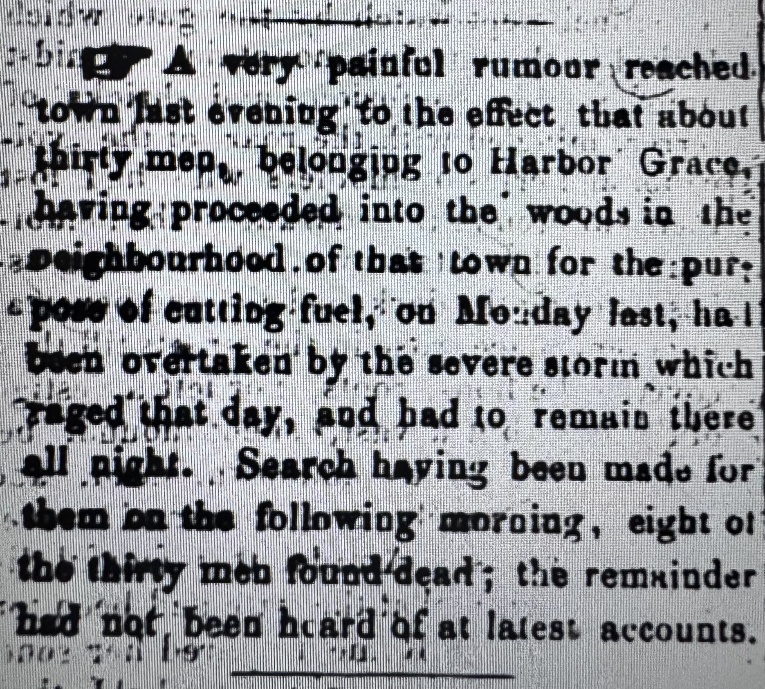
The St. John’s Daily Mail of February 6th expressed horrified disbelief:
A very painful rumor reached town last evening to the effect that about thirty men … had been overtaken by a severe snowstorm … eight of the thirty men found dead; the remainder … had not been heard of at latest accounts.
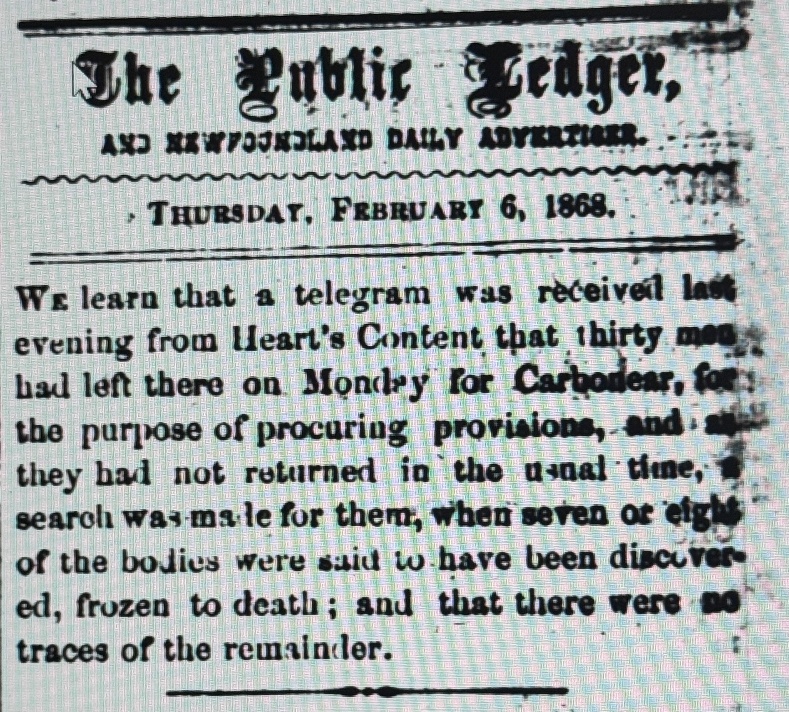
The Public Ledger and Newfoundland Daily Advertiser, also for February 6th:
We learn that a telegram was received last evening from Heart’s Content that thirty men had left there on Monday for Carbonear, … and they had not returned in the normal time, a search was made for them, when seven or eight of the bodies were said to have been discovered, frozen to death; and there were no traces of the remainder.
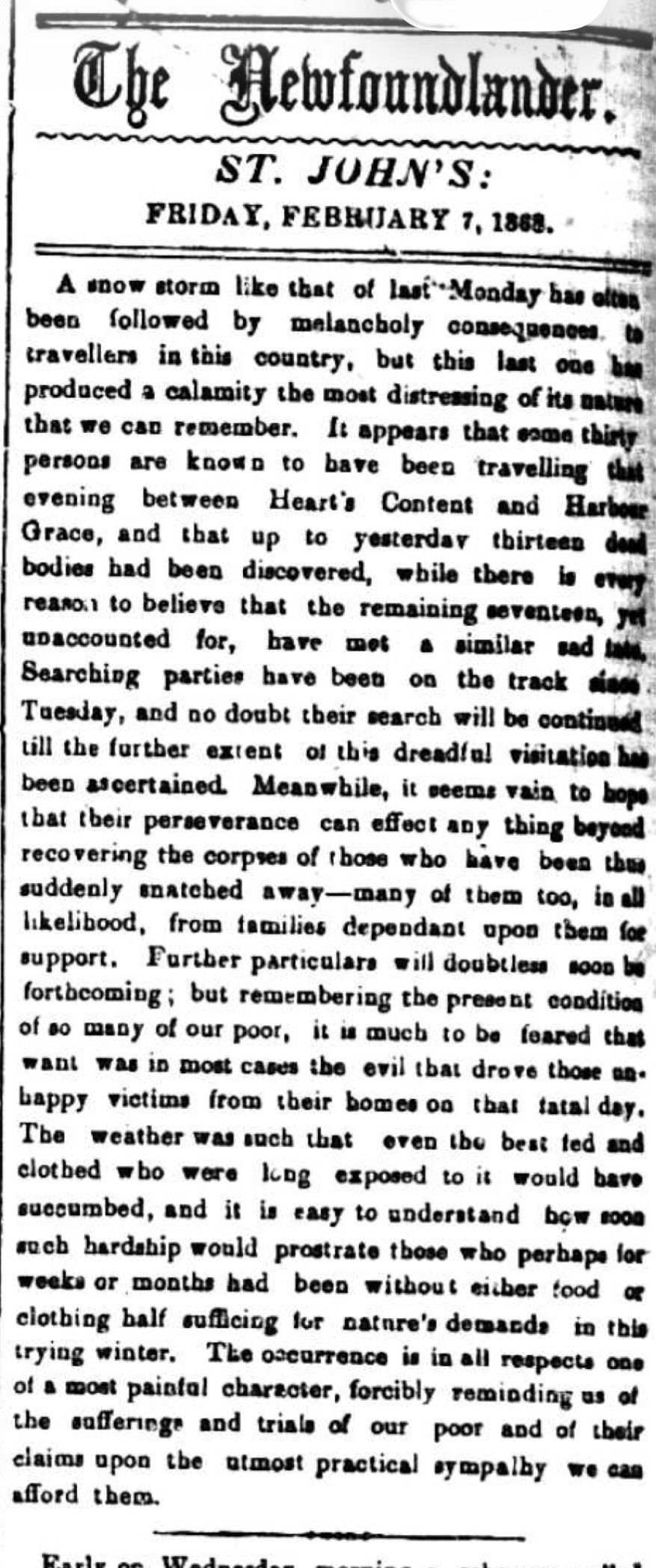
The account of the storm appearing in the February 7th edition of The Newfoundlander states:
It appears that some thirty persons are known to have been travelling between Heart’s Content and Harbour Grace, and that up to yesterday thirteen dead bodies have been discovered.
The same Public Ledger for February 7th adds:
thirteen dead bodies had been recovered, and that one boy was alive whose father and brother had perished”.
This same report also mentions a telegram from the previous day, stating:
Two children of Upper Island Cove, not yet found.
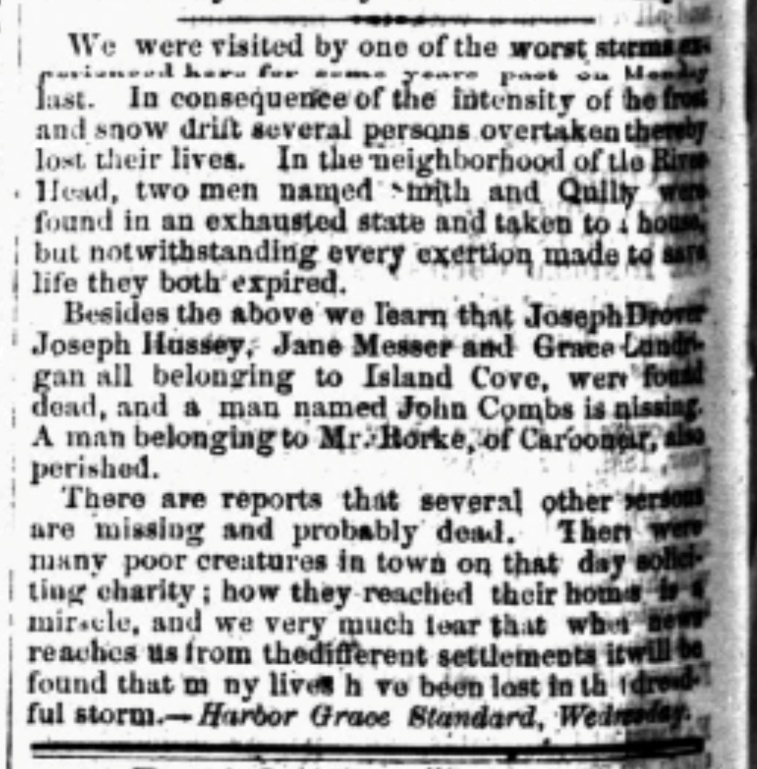
Continuing the next day (February, 8th), and after first emphasizing that “we were visited by one of the worst snowstorms experienced here for some years past on Monday last”, The Public Ledger reports: “Joseph Drover, Joseph Hussey, Jane Mercer, and Grace Lundrigan, all of Island Cove, were found dead, and a man named John Coombs is missing”. A man belonging to Mr. Rorke, of Carbonear, also perished”.
The February 6th telegram identified two children from Upper Island cove and the February 8th article identified John Coombs, also from Upper Island Cove. Folklore from Upper Island Cove adds that John Coombs’ two children, “Richard and Mary” also perished. 16
The St. John’s Daily News of February 8th, 1868, reports: “… In the neighbourhood of River Head, two men named Smith and Quilty” died from exhaustion. ,,, “There are reports that several other persons are missing and probably dead”.
A March 11th notice in The Courier: “A woman named Andrews, of Scilly Cove [Winterton], Trinity Bay, also died on the 3rd February, on her way to Hants Harbor, through the severity of the weather”.
Fifty-five years later Harry Mosdell recorded the event:
SNOWSTORM OF '68: on Monday, February 3, 1868, and was accompanied by terrible loss of life on the land. About thirty people lost their lives while travel-ling between Heart's Content and Harbor Grace; one man perished in Carbonear and two in Harbor Grace, five people belonging to Upper Island Cove were found dead in the snow. There was a high wind, terrible drifts and intense frost. 17
The thirty individuals caught in the storm were not all on the Heart’s Content barrens but rather in, and travelling between towns, in the general area, including Winterton, Hant’s Harbour, Heart’s Content, Carbonear, Harbour Grace, and Upper Island Cove. With some confused early reporting acknowledged, and no specific names referenced from Heart’s Content, one wonders if the father and his two sons who were out in the same storm with only one son surviving could be confused with a father and his two children, a son and a daughter, with all three having perished.
In any event, with Heart’s Content barrens being notoriously dangerous and a high traffic area, and with only 10 or 11 of 13, deaths identified as being from other communities, it is certainly possible that more of the deaths occurred on Heart’s Content barrens.
The only named victim of a February 1868 storm that has been associated with Heart’s Content barrens comes, it seems, from local lore as recorded by Melvin Rowe, but which cannot here be more formally attributed. This victim was reported as a New Perlican school teacher, Mr. Fenley, who perished while attempting to cross the Barrens that February. Rowe tells us that this is why “that lonely stretch of marshland mid-way across the barrens is referred to as Fenley’s Marsh”. 18,19
Of course, all these nuances are important only in an attempt to cross-reference and corroborate factual details. The more important point being: the storm of Monday, February 3rd, 1868, was particularly devastating, with much loss of life.
The Newfoundlander for February 7th laments:
Remembering the present condition of so many of our poor, it is much to be feared that want was in most cases the evil that drove those unhappy victims from their houses on that faithful day.
Recognizing a silver lining, Ted Rowe concludes:
It was a disaster of major proportion … [but it] prompted a move to [finally] provide a place of refuge on the road to Carbonear. By 1870 the Barrens had a halfway house with a caretaker. 20
There is little doubt that this storm played a key, if not decisive, role in finally securing the support needed for Government to allocate the required funds. We might remember though, that Newfoundland was still a very poor country and that previous attempts had failed, not because the need was not recognized but because there was so much other call on the limited financial resources of the government. Yes, the 1868 storm was particularly severe, but, with no specific details of the storm having a particularly severe impact on Heart’s Content, we might wonder if there could have been some additional new factor. Of course, such a factor readily presents. It was only two years earlier that the transatlantic cable link had been established. The business and political influence of Heart’s Content was growing, and its international significance was being recognized, both locally and around the world. To the extent that cable interests did play a role, this represents an early example of the public good that can get accomplished when business and civic interests align.
The Road: In the wake of misfortune and death along the trail over the immediately proceeding three winters (1833, 1834, 1835), 1836 saw a bill introduced in the House of Assembly by Mr. Keough and Mr. Rowe asking the Government to finally take action on seeing the road constructed. 21
A survey and report were commissioned for delivery by the end of June that same year. Completed by Mr. Joshua Green, the report described the route:
From Heart’s Content I have marked a line of road to the Barrens, about 3 miles toward Carbonear, leaving the Gunner’s Brook Rock Barrens a mile to the northward, thereby greatly shortening the distance and preserving an excellent line of road that way.22
From the reference to “shortening the distance” one might wonder: where was the original road? This is where Melvin Rowe recalls:
The footpath by which d’Iberville may have made his trip across the Barrens in 1697 had its starting point near the Main Brook Bridge. The narrow track then wound its way along the side of the Mizzen Pond, across the mouth of the Glam Brook, up the steep slopes of the Mizzen Hill and on to Gunner’s Rock to the fourth bridge. From there the newly-built road followed very much the old-time path.23,24,25
With the survey completed and the new route determined, and funds of 420 pounds (e $1,680) allocated, construction commenced immediately. 26 Some 15 men were employed at various tasks, including clearing brush and installing “bridges” for a path some 20 feet wide … over hills, through valleys and forests, and across streams and swampland. 27,28 Ted Rowe reflects the sense of appreciation: “That winter the men were hauling out firewood over the new right of way”. 29
This “right of way” could hardly yet be called a road, and further progress was surely not immediate. The slow or otherwise lack of progress prompted the following anonymously written letter published in The Star and Conception Bay Journal. 30
Sir:
You will be so kind as to let us no here what is the reason the Gentlemen dont begin our road that is to be finished between this and Carbonear as I have been told the House of Assemble gave 500 [pounds] to do it with but I hear it is own to one of the Gentlemen that was Commissioner has given up his place and there is nobody to take his berth. I think the road aut to be begun so that we may be able to get something to do instead of being idle and starving.
Your obedient servant,
A Harts Content man
Hart’s Content, May 31, 1838
Patches of road were worked on in a seemingly ad hoc and unsupervised manner over subsequent years. By 1846, “the inspector of roads and bridges was not impressed … [declaring]:
This is a miserable road for the outlay on it! – it is bad in design, and worst in execution … it is much regretted that this road … should not be in a condition to be passed by cart or other wheeled vehicle. 31
It cannot be determined when the road evolved to be finally considered “decent” for wheeled vehicles. For sure it contained low and winding sections susceptible to water erosion in the spring and fall, and drifting, white-outs, and blockage in the winter until the present modern construction was completed. These winter conditions of course can never be avoided, although road blockages are now lessened. And technology has helped. Before bulldozers came into use in the mid 1950’s winter travel had to be by foot or sled and road maintenance done by pick and shovel with a horse and box cart. Bulldozers were used for road maintenance and snow clearing until wheeled vehicles became necessary when the road was paved in 1971.
The Halfway House: The halfway house was built in response to tragedy. It was first and foremost a shelter from the harsh elements. It served principally as a lodging or rest spot for travelers in response to a long history of death due to exhaustion and exposure along the, then, path that led from Heart’s Content to Carbonear and Harbour Grace.
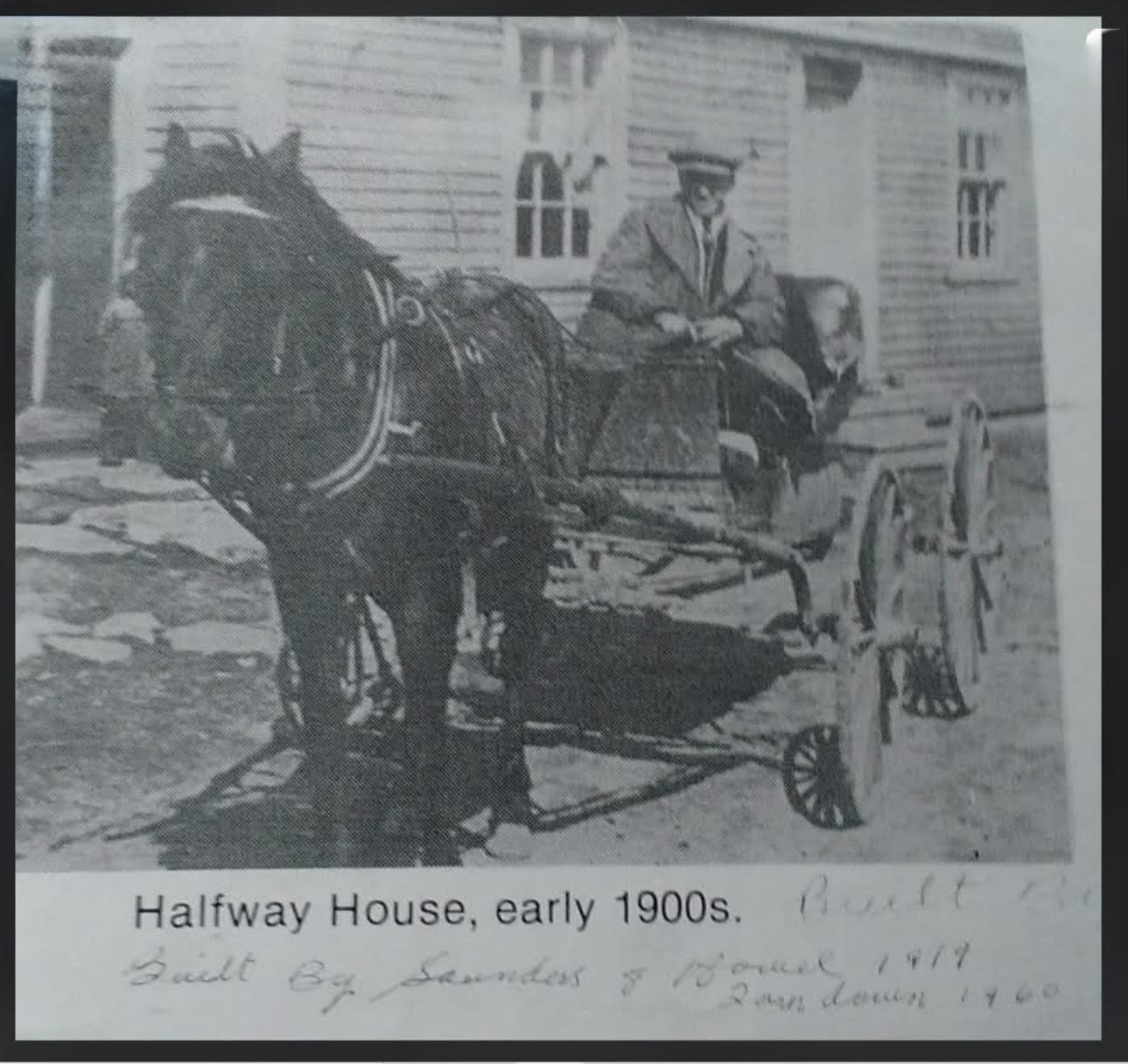
The Halfway House (from a photograph posted by the Mizzen Heritage Society) 32
There were two houses on this site. The first, shown in the adjacent photograph, burned down. See “Selected Photographs” below for a picture of the second house.
Description: A description of the interior layout of original house has not been found. Mrs Jean (Legge) George described something of the layout for the second house, recalling: It consisted of an open kitchen-dining area along the front and possibly three bedrooms along the back. One typically entered through the side porch.
Looking approximately North West
Neither Jean nor my brother, Frank, could recall where the water well was located. I seem to recall mom saying it was to the North East. Similarly, the outhouse was likely in or beside the stable, across the road.
The Barrens Route and Halfway House The Barrens in Winter
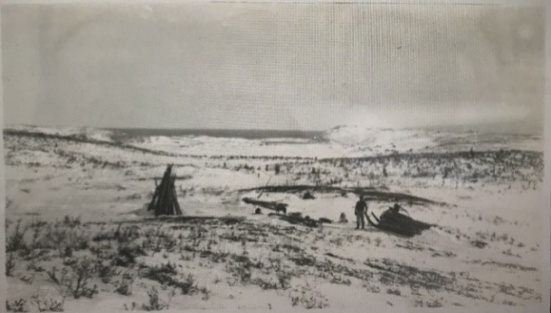
Halfway House
Constant Danger: Not even the caretaker was immune from dangers and tragedy. From the very beginning, caretaker Silas Ryall and his wife, Louisa, had to carry on while enduring their own personal tragedy - the death of their infant daughter there in the fall of 1871. And the general area offered its own constant dangers. The following from The Evening Telegram for September 10, 1923, illustrates; though this time with a positive outcome:
_________________
Astray all NightA message was received to-day by the Justice Department from Magistrate Penny, stating that Mrs. Burgess wife of the keeper of the halfway house between Carbonear and Heart’s Content who had been missing from her home since yesterday was found alive this forenoon. Men from Heart’s Content and Carbonear engaged all night in the search.
_________________
Contextual Observation: Reading the House of Assembly journals for these times one is struck by the constant themes of reoccurring tragedy (land and sea), the deplorable state of the roads and bridges, and the economic depravity of so many people. All in the context of limited government funds available to offer assistance. Politically, the big debate surrounded whether Newfoundland should join the Canadian Confederation.
Construction: What year was the halfway house constructed? Melvin Rowe (1976) settled on 1868. While it was around this time, 1868 turns out to have been a bit early, as this was the same year as the storm, leaving a short time window to acquire the needed government approvals and then to begin and complete construction. However, it does seem possible that perhaps a tilt or rudimentary shack could have been erected?
Ken Ryall (a descendent of the first caretaker), writing on the Heritage Heart’s Content Facebook Page (Sept 14, 2020) states: “Silas and family were at the half-way house in October 1871 when their 6-month-old daughter Emily died”.
The Journal of the House of Assembly for 1871 includes the 1870 wages for Silas Ryall, Keeper, Halfway House, in two separate amounts: $22.00 and $138.00, for a total of $160, equivalent to 40 pounds per annum. 33 This journal also shows a petition “From Silas Ryal, of Hearts. Content Road, for increase in annual Road Grant”.
With reference to a full annual salary for 1870, and no such previous reference, it may be speculated that construction of the halfway house could have been completed in 1869. Here Ted Rowe offers valuable insight:
Connecting the Continents (p 50), refers to October 26, 1869 correspondence from Weedon to Collett (his overseer in London) thanking him for a commitment of 50 pounds toward building a halfway house. He adds that he's sorry to say that the NF Company (operators of the telegraph side of the station) "will do nothing, so the 50 pounds will presumably not be granted." They must have found the money somewhere, since in correspondence of November 29, 1870, Weedon writes to H Renouf, Chairman of the Board of Works for Newfoundland, about finding a replacement for Daniel Sullivan who has been carrying the mail across the country to Heart's Content: "I propose Silas Ryall of the half-way house, who can read and write, as long as he can be replaced at the halfway house." So, it was built between October 1869 and November 1870. Given the time of year, and that they had no funds in October 1869, I'd put my money on sometime during the spring or summer of 1870. 34
It is useful to consider government’s approach to funding the house and the provision of associated public services. Considering such funding, almost 10 years earlier, James Rogerson (member for Burin, 1859 - 1861, and later Bay de Verde, 1870 - 1882), offered his thoughts. These thoughts would later become policy,
[T]he people had better build the house themselves and then get a subsidy of 30 or 40 pounds a year to keep it open. 35
Bert Parsons states:
The house came about by Pubic Subscription. The people of Heart's Content and others collected monies for this purpose and the Merchants helped, in particular, Rorke of Carbonear and Munns of Hr. Grace, two of the biggest merchants at the time. 36
The house was built by Ryall - The Journal of the House of Assembly, April, 1873, reports the Chairman of the Board of Works stating: “It was erected by the late occupant” [Silas Ryall]. 37
Ryall’s tenure did not last long. By 1873, government had decided to take full responsibility for the house, purchasing it from Ryall for 80 pounds, and hiring Charles George as his replacement. 38
The original house burned down in 1920, after operating successfully for 50 years. The St. John’s Daily Star for June 16, 1920, reports the destruction. 39 It was promptly rebuilt by Saunder’s and Howell. It was the rebuilt house that then operated until 1956 when John Cumby retired and the government decided to no longer operate the facility.
Formal documentation has so far not been found for either electricity or telephone service at the halfway house. From the “Faithfull Dog” article (reproduced in the Appendix below), it seems there was no telephone there in October, 1941. There is verbal evidence from three area residents, old enough to remember, who state that there was telephone service but never electricity. All three refer to the period that John Cumby was caretaker. One saying: “Hannah used to use it all the time”. Whatever the precise date that telephone service was installed, both lines ran right past the house by February, 1905. 40 A telephone would have most certainly represented a great leap forward in improved safety and convenience for both the public and the caretakers.
Builders: We know that Silas Ryall built the first house, or oversaw its construction. With Newfoundland’s extensive shipbuilding industry, it would not have been hard to find qualified carpenters who could do the job, in Carbonear, or in Heart’s Content. Indeed, this is an important source of the tradition of Newfoundlanders building their own homes. We might wonder of the extent that local government representatives (e.g., John Rorke) might have exercised in identifying a builder. Indeed, John Rorke and Sons could easily have undertaken this work, although there is no indication of this.
For the second house, it may be important that it would have been an official government structure. This suggests a requirement that it too be built by qualified builders and with some quality. Saunders & Howell was the reasonable choice. Construction was completed by September, 1920, under the supervision of Mr. Augustus Bridle. 41
Caretakers: Silas Ryall was the first caretaker (formally referred to as “Keeper”) of the halfway house. Here-to-fore, the most often other identified caretakers are reflected in Frank Clarke’s list - “Robert Burridge, John Hopkins, Jack Cumby, Walter J. Clarke”. 42 An important name, seemingly confused with Burrage, is Robert Burress. Burress was the longest serving caretaker, 1919 – 1937. Next were Robert & Annie Rodgers (with son, Frank), and Frank & Rebecca Legge (with their daughter, Jean). The Rodgers’ were caretakers from October, 1937 to July, 1942, inclusive. Jean George states that her family was there for 3 years; thus, c 1942/43 to c 1946. Ed Cumby, John’s grandson, states that John Cumby (Jack, in Clarke’s list), served from 1952 to 1956. Frederick John “Jack” Cumby was the last caretaker of the halfway house. Well, of the halfway house that became owned and operated directly by the government for some 65 years, until it was sold to private interests in 1956/57. Other caretakers are identified below - see: Summary - Caretakers Timeline.
I beg the reader’s indulgence in observing that dad, Robert (Bob) Rodgers, was also a long serving caretakers, when we consider the halfway house and the Heart’s Content barrens road together. Rodgers served as caretaker from 1937 to 1942. He then, on a part time basis, guided travelers across the barrens, on foot and with horse and cart, between ‘42 and ‘55/57, at which time he transitioned to heavy equipment, first with a bulldozer, until the road was upgraded and paved in 1971, and then with a grader and truck-plow/sander until his retirement in 1977 – totalling over 25 years. Dad was “lucky”. Technology and stronger government finances enabled him to help extend services to travelers that were not previously possible. “Stuck on the Barrens” was surely still ever present, but severe exposure and death were by now gone.
Duties & Salary: Reporting on the legislative proceedings of the House of Assembly, The Public Ledger for March 2, 1875, provided a summary of a petition by Ezra Weedon and others from Heart’s Content and Carbonear “preying” that the salary of the keeper of the halfway house, by then, Charles George, be increased.
House support for Weedon’s petition included:
Mr. Watson emphasized that the keeper of the half-way house is very inadequately paid, receiving only the small sum of 40 pounds per annum, and being bound to keep six miles of the road in repair. The traffic over that road had increased largely of late years, and the necessity of such a house of refuge, especially in winter, is very great, unlike other keepers of half-way houses, ferries, etc., that petitioner had not the slightest means of adding to his miserable income. He could not fish, and the house is so situated on the barrens that agriculture is out of the question.
Mr. Rorke had much pleasure in supporting the prayer of the petition. Considerable protection had been afforded to the people travelling over that road by having such a stopping place. He looked upon such houses as not second in importance to lighthouses in the benefits they conferred on travellers. The traffic on that road had increased immensely since the establishment of the Anglo-American Cable Company’s office there at Heart’s content, where their cables are landed, and is twenty-times as much as it was ten years ago. The salary charged to the person in charge is too small, and besides services are required of him in keeping the road in repair. The halfway house is situated on the edge of the barrens … and during the severe weather we have had lately, no doubt many a traveller overtaken by snow storms took advantage of that place of safety. It was the duty of the House [of Assembly] to see this service satisfactorily performed, and it would be money well spent.
The Surveyor General emphasized that it was a matter of astonishment that the keeper of that house was not on the same footing as the keeper of the halfway house on the road to Placentia.43 The petitioner … is bound by the Board of Works to keep six miles of the road in repair. That service occupies all of his attention, and he has therefore, no means of adding to his small income. [Furthermore], the keeper should be provided with a horse and cart. Then some efficient work might be done by him on the road, and the Board of Works would save money by it. To present with only a wheel-barrow it is impossible for him to do the work efficiently.
The petition was successful. While this specific new salary amount has not been here researched, the Public Services Act 1905 shows that it had by then been increased to $280. The following table illustrates. 44
Halfway House - Annual Salaries (1905)
Keeping Halfway House, Salmonier $162
Keeping Halfway House, Heart’s Content to Carbonear $280, $350 in 1920
Keeping Halfway House, Trinity to Catalina $200
Keeping Halfway House, Renews to Trepassey $ 40
Privatization and Demolition: By 1956 the need was much reduced, as a significant province-wide roads upgrading program was underway and mechanized heavy equipment was available for road maintenance and snow clearing. Accordingly, the government decided to close the halfway house. Other such houses had already been closed. The Evening Telegram of January 19, 1957, reports that, the halfway house will “reopen” for the Winter of ‘57, “but it will be operated under a new arrangement and not directly administered by the works department” and that “at the present time the house is open and is being operated by a department employee and there is a stove, a telephone, and other accommodations in the house”.
Evening Telegram, January 19, 1957 Evening Telegram, February 21, 1957
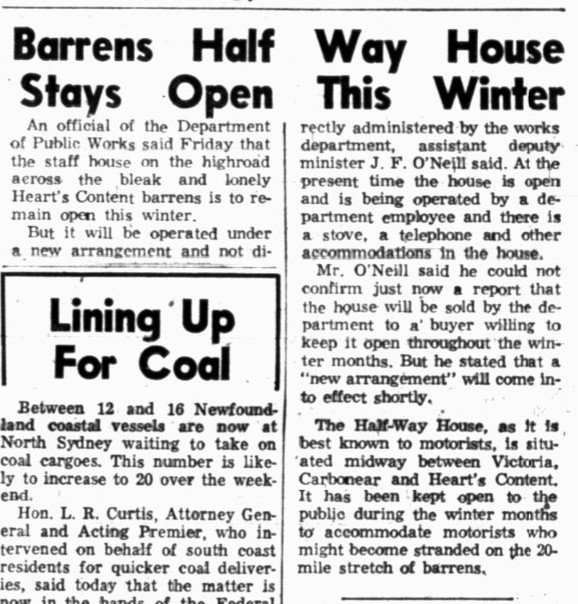
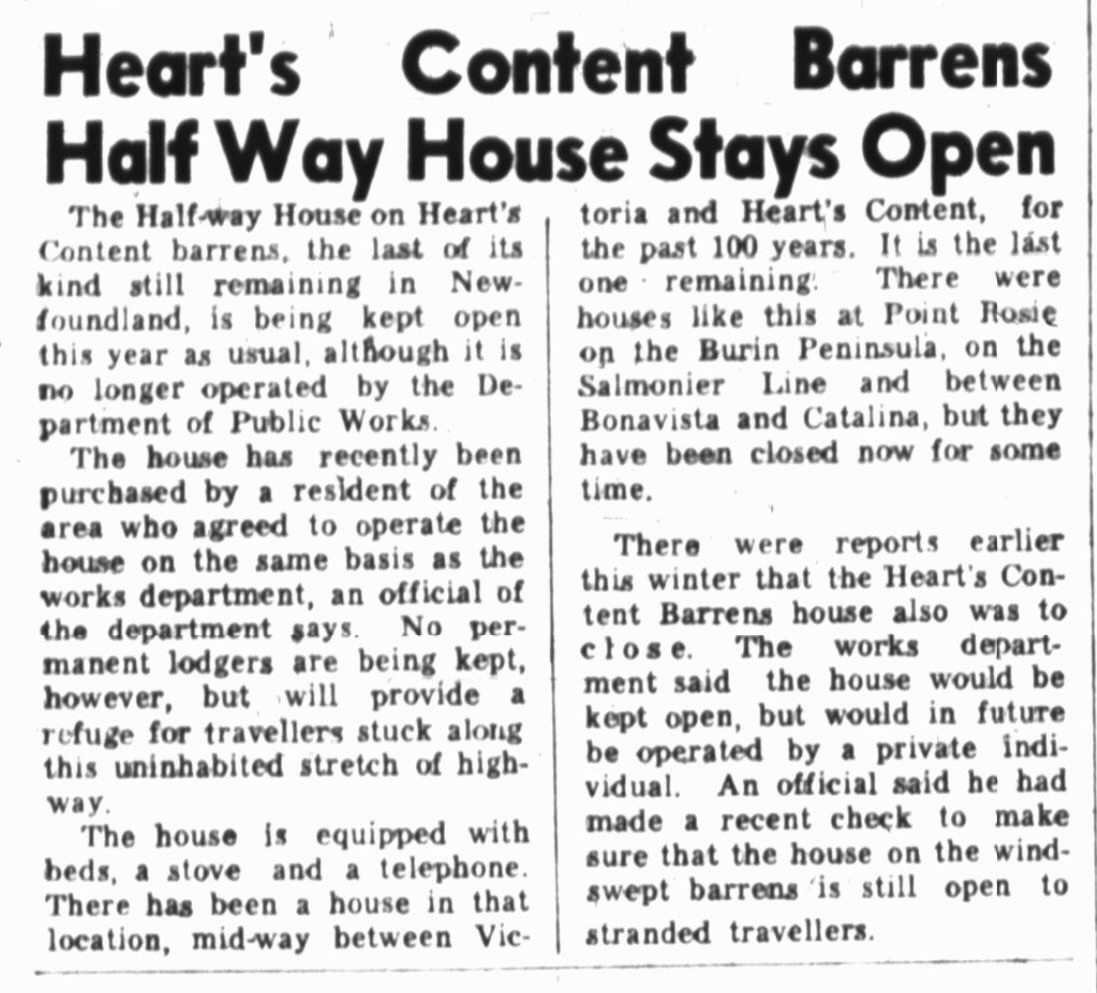
The February 21, 1957, article tells us that government’s interest in the halfway house has been privatized:
The house has recently been purchased by a resident of the area who agreed to operate the house on the same basis as the works department … No permanent lodgers are being kept, however, but [it] will provide a refuge for travellers stuck along this uninhabited stretch of highway.
The resident referred to was Walter J. Clarke, a Victoria businessman. Clarke would have been there a very short while - aligning with the memory of Arnold Pitcher.
During the brief period when Clarke owned the house, the Wagner family of Riverhead, Harbour Grace, made an “attempt” at operating it as a restaurant and lounge. 45 This venture soon failed, seemingly with no great surprise.
Clarke subsequently sold the house to William (Bill) Swain of Carbonear, who tore it down. The salvageable material was used in the construction of Swain’s son’s house, on Saddle Hill in Carbonear.
As to timelines, we know from photographic evidence that the house was still there, c April, 1960. My personal recollection (See Appendix - Selected Personal Photographs below) is that the house was not there in April, 1961, and that it had only recently been removed, suggesting that it had been torn down in 1960. This implying that it was sold in 1960, or perhaps 1959.
Halfway House, Late 1950’s Halfway House, 1960
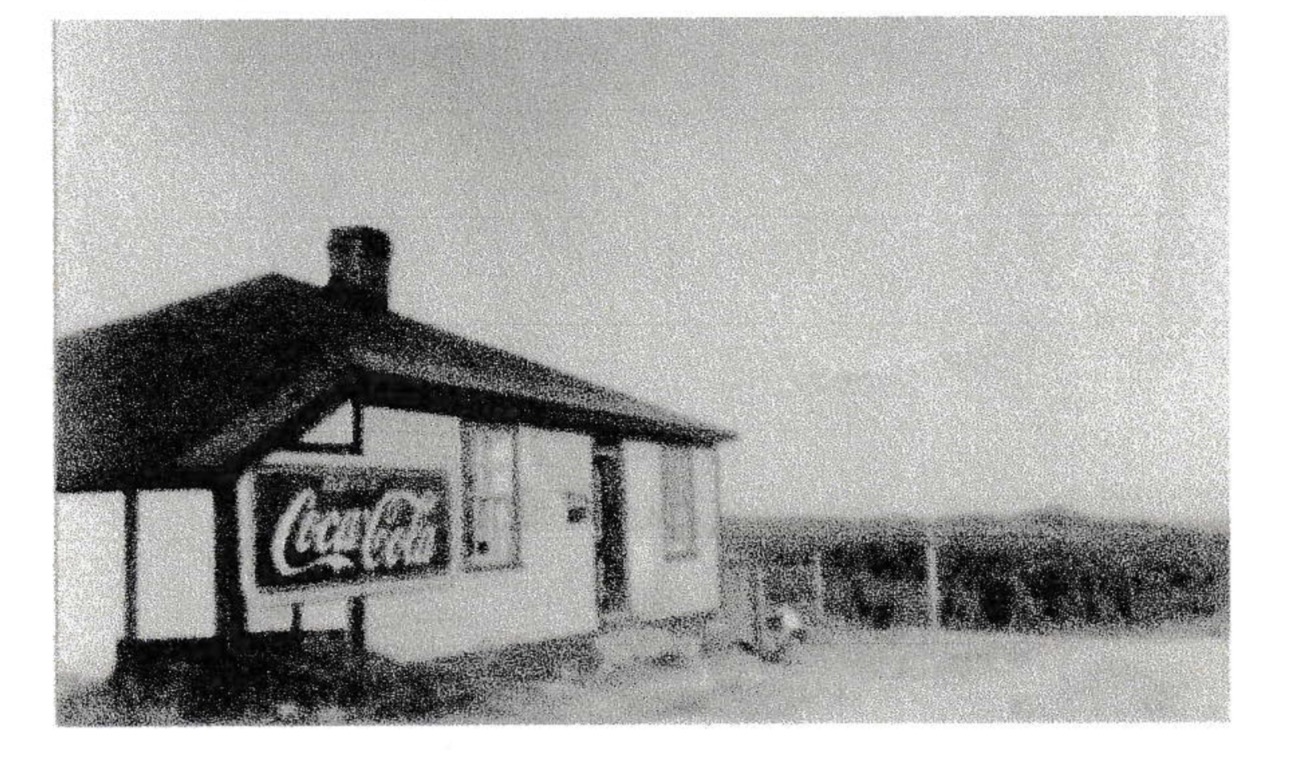
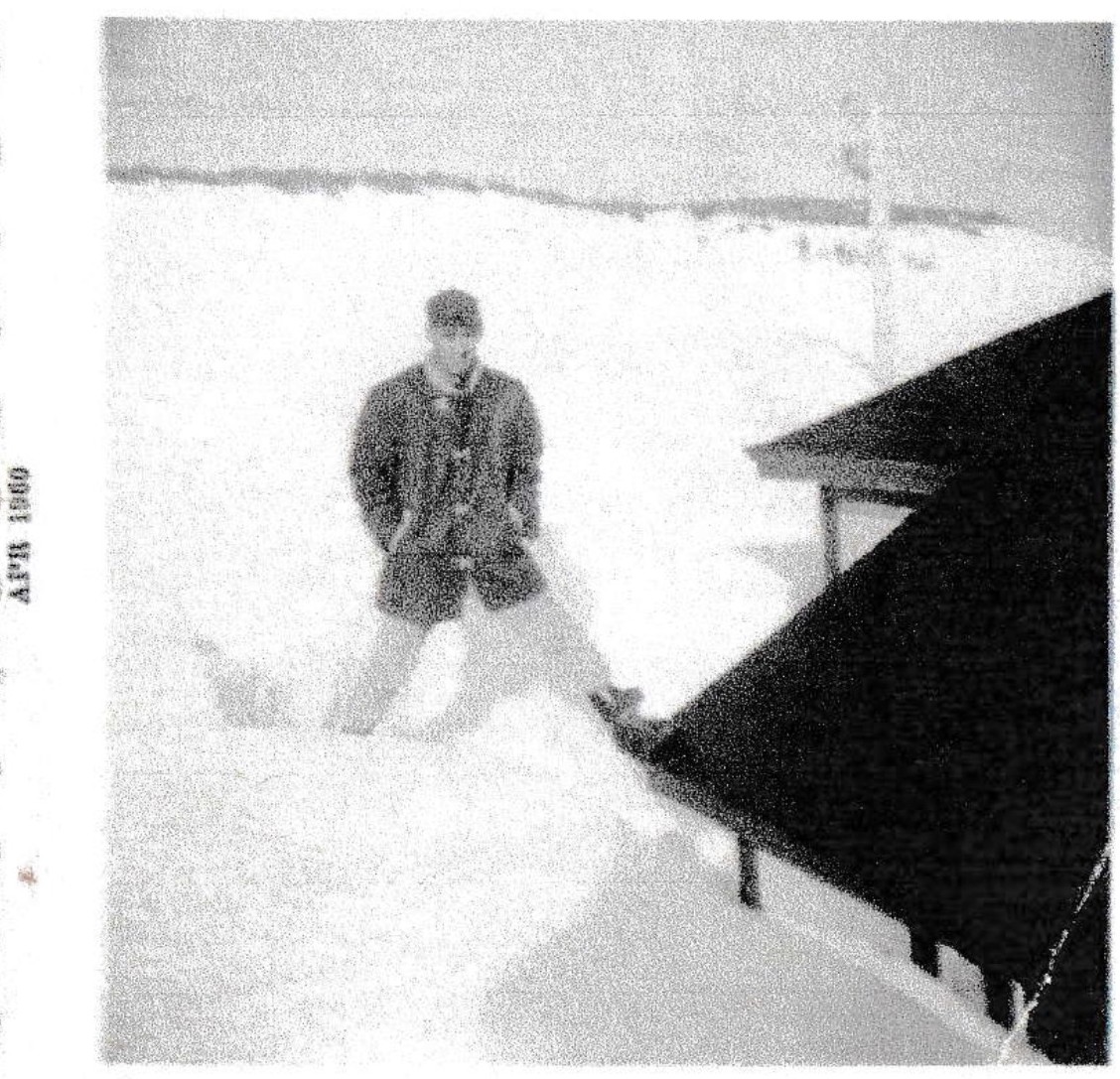
Photographs Courtesy of Bert Parsons, Carbonear
A Word of Thanks: If there is a resident guru on all-things Heart’s Content barrens – the road, the halfway houses, the power and telephone lines, the events, and the people, it is Bert Parsons, of Carbonear. Bert has long diligently and passionately researched, and uncovered the obscure and otherwise hard-to-find details. He surely has saved much history from being lost.
Summary - Caretakers Timeline
1870 House built by Silas Ryall, funded by private doners,
Operated by Government1870 – 1872 Caretaker, Silas & Louisa Ryall
1872/73 Government purchased the house from Silas Ryall
1873 – 1893 Caretaker, Charles & Mahala George
(Charles George died at the halfway house)1893 – 1898 unidentified Caretaker(s) **
1899 – 1903 Jonathan (John) Hopkins
1904 Joseph Rowe, recorded as Joaeph1904 – 1906 James & Susannah Ollerhead
1907 – 1910 Charles & Mary Wright
(Charles Wright died at the halfway house)1911 – 1913 James Langer
1914 – 1917 Henry T. & Harriett Sooley
1918 – 1919 Richard George
1919 – 1937 Robert & Mahala Burress
1937 – 1842 Robert & Annie Rodgers
1942 – 1946 Frank & Rebecca Legge
1946 – 1952 unidentified Caretaker(s) **
1952 – 1956 John & Hannah Cumby
1956/57 House sold to Walter J. Clarke (Victoria)
1959/60 House sold to Bill Swain (Carbonear)
1960 House demolished
** Bert Persons has done a remarkable job in uncovering the names of caretakers. The name,
Burress was particularly difficult to verify, alternatively reported as Burroughs, Burroughes,
Barrers, Burgess, Buress, and Burress. The latter from their daughter’s baptismal certificate
and corresponding with the census for both 1935 and 1945. This confusion seems to also
extend to Burrage. The census record makes no reference to either Burroughs or Burrage.
When Jean Legge George (Heritage Heart Content Facebook Page) stated: “My father
operated it too, Frank Legge, and Robert Rodgers, and Robert Burroughs”, she is almost
certainly referring to Burress, easy to misinterpret when heard and perhaps not seen in
written form. Also, Parsons suggests that there may have been more than one caretaker
during the tenure of Burress, possibly Ray Legge, for a short while.
While not applicable to the period, 1946 – 1952, it should be observed that the unidentified
caretakers** could indicate imprecise information for those immediately preceding and
following. In some instances, and without specific documentation, the end of a tenure is
determined by the caretaker’s death; e.g., Jonathan Hopkins died in November, 1904, after a
“long illness”, however he is reported, in September 1902, to have been in “very poor health”,
and his successor, James Ollerhead, was already established as caretaker by 1904, before
Hopkins’ death. The Newfoundland Yearbook and Almanac for 1904 shows Joaeph Rowe
(taken to be Joseph), who could possibly extend back to 1903. Research is ongoing to
determine the names of the unidentified caretakers, particularly for the period 1946 – 1952.
Personal Halfway House Stories:
Honeymoon: Recently married and with responsibilities, Dad needed a good job, which he found as the caretaker at the halfway house. Maybe mom found it for him? This would have been a shared responsibility with Mom. In addition to road maintenance, Dad would have looked after the horses, ensured the necessary provisions were on hand, including fire wood, and taken passengers to and from Carbonear and Heart’s Content as needed, and on demand. The stable (the barn) for the horses was across the road from the house. Mom’s role would have been to provide meals and assist with other chores, including, I suspect, most/almost all of the parental responsibilities. I understand that the house had, perhaps, two stoves, three bedrooms, and a large kitchen, which also served as the dining room. I believe the well for fresh water was a short distance to the right in the photograph. The latrine is thought to have been in or beside the stable.
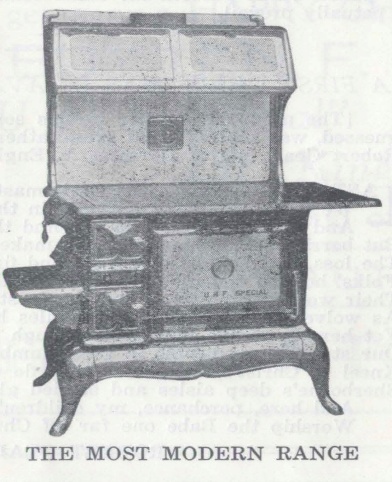 U. N. F. Special: Alex Rowe found a receipt in the records of John S. Rowe & Sons store showing that dad had purchased a kitchen range just before moving to the halfway house in the fall of 1937. Made by the United Nail and Foundry Company of St. John’s, it was a beauty! It cost $93.50, which I estimate to be perhaps one-quarter of the keeper’s salary at that time. Dad paid in installments over four months. It was transported to the halfway house by horse and cart. I recall mom talking about assembling the stove and about how heavy the pieces were. There are of course a number of reasons why the house may have needed a new stove. It may be that mom wanted a better stove. In any event we used that same stove until the mid to late 1960’s. I will of course never forget warming my feet on the open oven door after skating.
All Sorts!: Mom did mention in passing that not all visitors were well behaved! Although she never mentioned any sort of violence, she was glad to have dad around. Essentially all of her halfway house stories were funny or pleasant.
Bombs and Snow: The snow drifts often approached the eves of the house and the tops of the telephone poles (which, admittedly, were not so tall in those days). Mom told a war-time story of being surprised by a terrible loud noise. She shouted “Bob, it’s a bomb, it’s a bomb”. Instead, the runner of the mailman’s sled, being pulled by a horse, had hooked the eve of the house. Apparently, the driver was, in Mom’s words, and with affection, “a devil for driving too fast”.
Skating: I recall mom saying that she and her sister, Marjorie, would take Frank a short distance on a sled to a pond on the same side of the road. It may have been Bob Ayles’ Pond? I seem to recall mom saying that Marjorie would skate.
Constant Traffic: In the fall the constant traffic increased as sportsmen from Carbonear and elsewhere were often out for a day birding on the barrens. This just added to the normal traffic from working travellers or folks anxious to take care of some business in Heart’s Content or Carbonear, and beyond.
The Boy: Frank said that he was 5 years old before he realized that his name was Frank and not “The Boy”. I suppose that so many transient visitors would refer to him that way. In fact, it wasn’t uncommon to hear grandparents say “your boy” when referring to someone else’s son. In the days of 10 or 12 children it was perhaps hard for non-family members to keep names straight. Indeed, dad’s conversation would often mix up me and Frank! Otherwise, he had a fantastic memory.
Bill Squires - A Crusty Story: This story comes from the late Bill Squires (1926 - 2024, Sibley’s Cove). It was related to me by his close friend, Mr. Ray Tuck (Hant’s Harbour). Anybody who knew Bill knows that he was the anthesis of crusty! He was a genuine people person! I have fond memories of both men, as I recall my dad often mentioning both of them. Mr. Tuck’s recollection:
“I remember the halfway house on the Barrens. One story that I recall was told to me by Mr. Bill Squires, who started taxiing on the shore in 1947. … I recall: His father had a trucking company (1 Truck) and at that time, the roads were not open in the winter. Bill did a lot of driving with his father, and one day his father said, "Bill, do you think we can get to Carbonear today?” Bill wondered why his father would ask such a question, but his father replied, “I think we can get across on the crust of snow.”[Readers need to recall that in those times the snow that fell in the fall did not get plowed but instead built up over the entire winter with each succeeding snowfall. And the crust hardened with the constant wind the successive layers of frozen rain.]. … Anyway, they tried it, and sure enough they travelled right across on the crust of snow. The only place they got stuck was at the halfway house where the horses had broken through the crust with their hooves”.
War-time Tragedy: Jean (Legge) George related the sadness that she recalled witnessing as a small girl living at the halfway house when the casket of the 16-year-old Patsy Cumby (daughter of John and Elizabeth) was being transported by horse and cart over the barrens to Heart’s Content following her tragic death in the December 12, 1942, St. John’s fire that destroyed the packed Knights of Columbus hostel.
For Love: Ralph Stentaford told the story of how, being caught out in inclement weather, the halfway house became a much-welcomed refuge, facilitating his forthright and determination march to cross the desolate and dreaded Barrens, not for needed provisions, not for sporting, nor even for business, but for love. Ralph just had to get to Victoria to see the most beautiful young Elizabeth Clark, daughter of Abel Clarke and Jessie (Vatcher) Clarke. Elizabeth was the girl of his dreams. From the center of world telecommunications to the halfway house and on to the Big Apple, little did they both know, or even care, where the future would take them. Together they met their challenges with dignity and enjoyed very much their many successes with humility and gratitude for lives well lived.
More Love: Wilson (Wills) George from Heart’s Delight, married to dad’s sister, Blanch, told the story of walking from Heart’s Delight and across the barrens from Heart’s Content to Carbonear and home again. His purpose: to meet the train and pick up a very important parcel. The parcel – aunt Blanche’s wedding dress. Blanche and Wilss were married in August, 1942. It is certain he would have stopped at the halfway house – going and returning. Maybe dad, or someone else, gave him a lift? The discussion of his purpose would have been exciting.
Faithful Dog: The “Carbonear Notes” section of the Observer’s Weekly, October 21, 1941, contained a story entitled “Faithful Dog Saves Life of Sportsman”. 46 Mom earned an honourable mention for serving lunch to the search party. Apparently, she was assisted by Magistrate Ash and Reverend Davis. Everybody pitched in. The article is reproduced in the Appendix below.
Kindness – Gordon Elliott’s Story: Though kindness and hospitality seem to be constant themes, it seems that the food available in the fall of 1941 was more-tasty that that on offer in 1908, The Heart’s Content Heritage Center site recounts a December, 1908, story of Gordon Elliott, a student from England studying in St. John's, who was invited to spend Christmas with a cousin in Heart's Content.
Following instructions, he took a train to Carbonear, where he was to meet a slide that would transport him across the snowy barrens.
As they climbed higher, snow piled up. and eventually, they became completely snowbound. Unable to push through the drifts, they were forced to stop for the night at the halfway house.
The young Elliott recounted his experience:
“I enjoyed the night. I had some bread and I had some margarine. I had a little cup of tea... I didn't like the tea very much, because I couldn't get any milk... but they were very kind... We were sitting up there and men were smoking and yarning, you know? There were three or four others that were stuck there just like ourselves."
Fish Cake(s): Lorne Tuck of Hant’s Harbour told the story from 1956 when they were hauling steel by night from Carbonear to New Chelsea. They stopped at the halfway house for a cup of tea. As soon as they crossed the threshold, he spied, and immediately grabbed, the one lone fish cake that was still sitting in the pan on the stove, only to be immediately caught in the act! The caretaker’s wife, Hannah, did not miss a beat, declaring - “That’s all right my son, the dog wouldn’t eat that one”.
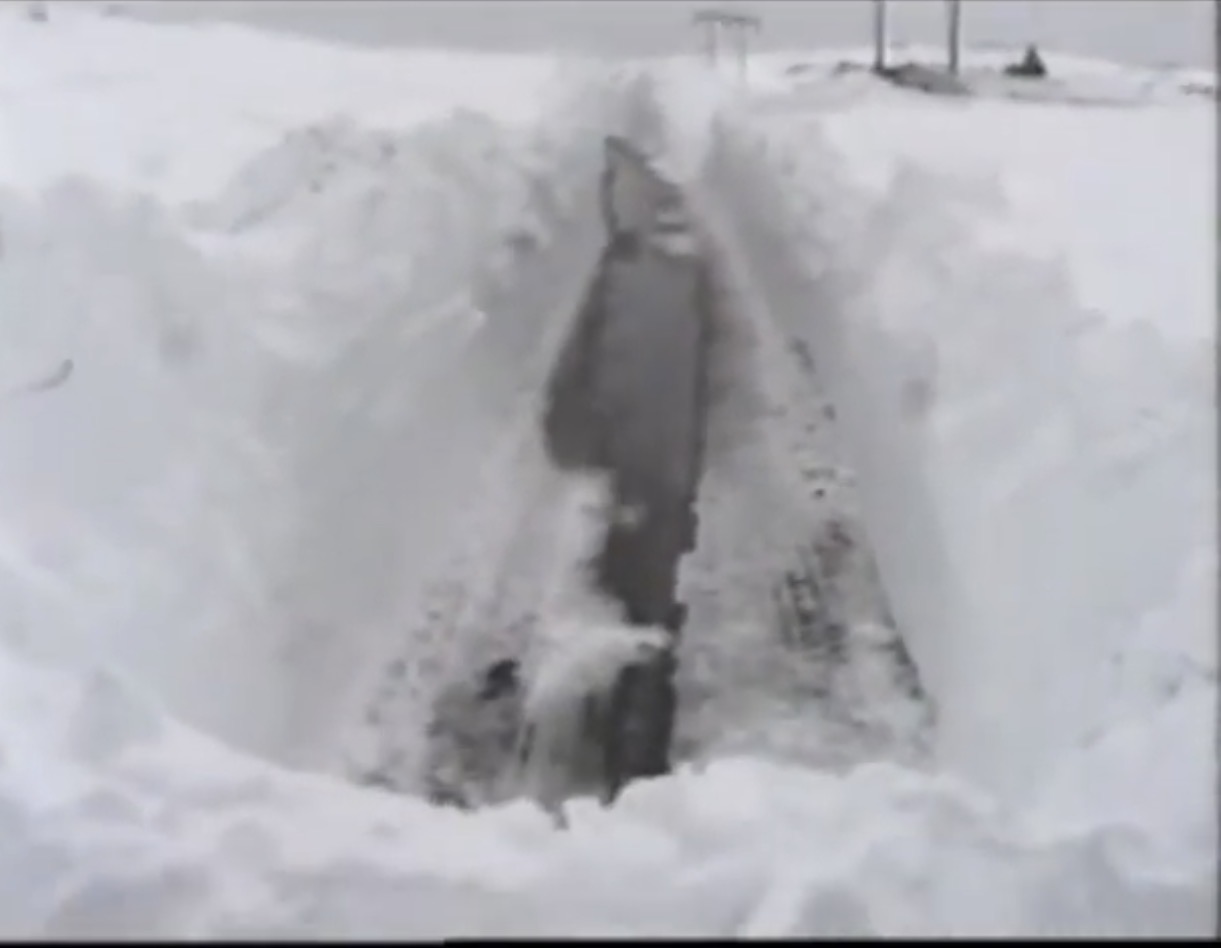
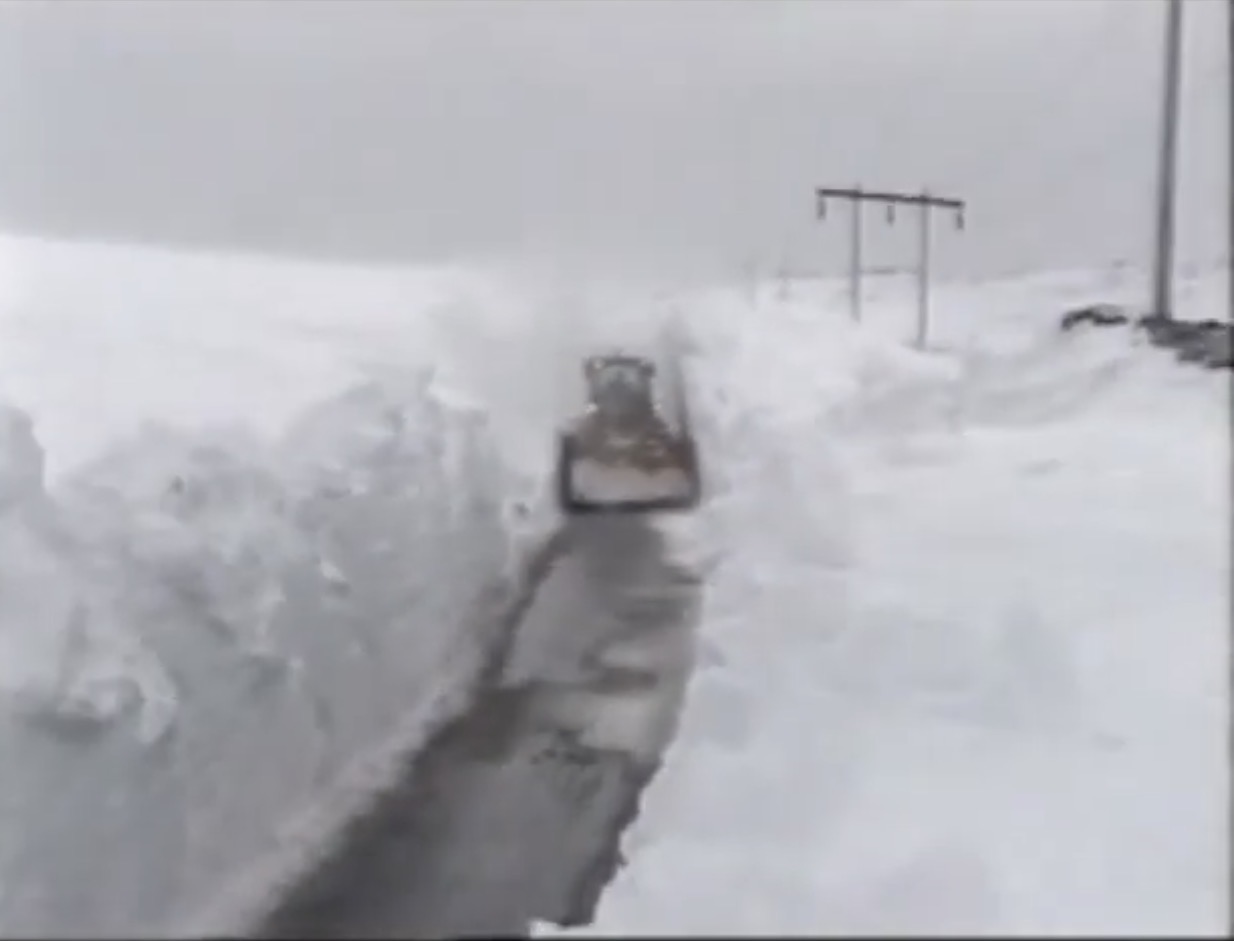
Barrels for the Well: Another story told by Jean George is that, on at least one occasion, her father had to place 5 or 6 barrels on top of the well in order maintain access to drinking water. This implies a snow depth approximating 5 meters (c 15 feet).
In case readers cannot imagine such snow, evidence is offered by the following photographs, taken as screenshots from a video made on April 7th, 2001.
Snow Clearing – Heart’s Content Barrens Near the site of the Halfway House
Off Course: I also recall at least two incidents where dad had to rescue a coworker. It was in the mid to late 1960’s. By this time, if memory fully serves, the Department of Highways had allocated funds for a helper to assist dad so that the Heart’s Content depot could be manned day and night during the winter. This facilitated quicker snow clearing during and after storms and a more rapid response in case of emergencies. I recall dad, after his day shift, being called out of bed in the middle of the night because, in the blinding snow, his relief had veered off the road and gotten the bulldozer stuck in the soft snow and underlying bog. Who knows how often dad traveled (walked, and with horse and cart) from Heart’s Content to Carbonear in his youth and before 1937, and then from 1937 to 1942 while he was caretaker. It is quite likely that nobody knew that road anywhere near as well as did dad. From the accounts of his coworkers, he seemed to be always fully aware of his location, even when the storm made vision impossible!
Winter Rescues and Mutual Respect: The provincial government representative in the House of Assembly for Trinity South was James Reid from Heart’s Delight. Dad sure had a lot of respect for “Jim”, and long before he became our MHA. This not withstanding, I would not bet that Mr. Read got dad’s vote. Then again, he might have? I recall one evening in the winter. Dad had been plowing snow earlier in the day to open the road across the Barrens. A part had broken on the bulldozer and dad was now home waiting for the part to arrive from St. John’s. Who should show up with the part but Mr. Read. Later, when dad returned home, and the road now open, dad was so appreciative; yes, that Mr. Read had brought the part, but, more, that he helped dad to install it. Decades later I told this story to Mr. Read’s daughter, Patricia. I was surprised when she immediately said – “And dad certainly respected your father”. Patricia then recounted her own story of how her car had gotten stuck in the snow while she was travelling from Heart’s Content to Heart’s Delight, emphasizing how thankful her father was when dad had rescued her, enabling her to get home safely. Yet another winter storm rescue story comes from Alexis Hicks, who, when reminded by her brother, Jonathan, that dad had rescued their family on the Barrens, said that she considered dad to be a “hero”. Kind words from kind folks!
Advice Not Heeded: Bobby Balsom recounts - We were waiting in Victoria one stormy evening for your father to come our way with the plough so we could go back behind him to Heart's Content. When he arrived, he told us strictly to stay behind the plough until we reached Heart's Content. We did, until we were part way across the Barrens when the lights on the plough started to go off and on. We then thought that he was giving us a signal to pass and that the road was ok from here. So we passed your father for a very short distance and suddenly found ourselves stuck in a huge snow drift. Very soon your father was upon us asking us what the hell we were doing. I told him about the flashing lights on the plough thinking it was a signal for us to pass. "Don't give no heed to that boy, the lights never did work right on this." So needless to say, we stayed behind the plough until we reached Home.
Preventive Medicine: A certain gentlemen of Heart’s Content had no fear. Not even of The Barrens. If he decided he wanted to go to Carbonear he would not be deterred, no matter what the road conditions. I am sure he new that if worse came to worse, he would be rescued. Such shenanigans, however ill-advised, could offer opportunity for fun. If road conditions were bad and dad was heading from Heart’s Content across the Barrens in the bulldozer, he would have a good idea if this gentleman was likely to follow, himself becoming stuck or otherwise slowing dad’s progress on the task at hand. To prevent this from happening, dad would some tines leave an impassable ridge of snow across the road near Heart’s Content in order o prevent our daredevil from venturing forth. I am sure both of them had a silent chuckle.
A Public Service: As the Barrens-road became upgraded over the years, a number of low turns were removed. These sometimes became side roads, often cul-de-sacs. In the winter-time dad would plow snow higher around these areas in an effort to provide privacy off the new road for some that he knew might be looking for a secluded place to park and hide away. I can imagine the smile on his face as he did this important work.
Fond Memories: A story similarly recounted by others. this time from dad.
There were lots of travellers in those days, such as people going to Carbonear or St. John’s looking for a berth to the seal hunt and conducting other business. There were berry pickers. And there were sportsmen out for fun and a day on the barrens. The Halfway House provided warmth and shelter for the weary traveller, a bite to eat, a nice cup of tea, and an opportunity to catch up on the news.
No Relief for the Horses: While the following is not a halfway house story, I imagine it offers a glimpse into some of the summer-time conditions, especially in low-lying swamp-like areas along the road. Again, it is a bit of a stretch to refer to this as a road. A better reference at some times and in some locations would be an ATV trail.
After leaving the halfway house in 1942 and until he secured the job of bulldozer operator in the mid 1950’s, dad’s job was now to maintain the road, drainage ditches, and bridges/culverts from Heart’s Content to the halfway point before Heart’s Desire. His life-long friend, Patrick Saint George (Pats, or Patty) from Heart’s Desire would maintain the other half.
Both roads followed the natural contours of the land. The difference between this road and that over the Barrens was dense trees and bushes on both sides, such that one could feel more like being in a tunnel as the trees and other brush came right to the road-sides. This meant – No Wind! In the spring and summer, the “flies” (mosquitoes) could be ferocious, and always maddening!
In order to provide some relief for the horses, dad said that they would set a sod to smolder underneath the horses as they waited for the road-work to be attended to and the cart to be loaded - the smoke providing a little of the sought-after relief for the horses. There was no relief for the men!
This work needed to be done every day, especially during inclement weather when washouts would be frequent and appear from nowhere. The work was all done with pick, shovel, and rake. In addition to these tools, the only other capital assistance was their box carts, horses, and the related tack, and the men’s oil-skins. I cannot recall dad ever mentioning that he received any extra remuneration for his capital.
Dad, and Pats too, both said that they looked forward to Friday lunch-time, as this is when they would happily meet at the half way point for a “mug-up”, and a yarn. The men would later make their way home for the weekend and the constant chores and responsibilities that awaited there. Frank could recall the crunch of the cart wheels against the road gravel as dad arrived home just before supper, careful not to be early or otherwise seen to be unappreciative of his good fortune to be gainfully employed.
Back to The Depot: Why was the highways depot located at Heart’s Content? Because it was at the intersection of routes 80 and 74, and closest to the Barrens. Logic and common sense notwithstanding, this may have almost not happened! It had been agreed that the depot would be located at the Cross Roads. On the appointed day dad was waiting, and watching. When materials started to arrive, they went past the Cross Roads and on to a mid-way point with another community. Dad suspected the new destination. Certainly nothing against the other community, but suspicious that this might be no accident and that local politics might be at play, he followed. When they began to unload, dad stood his ground, declaring that they were in the “wrong” location and that the higher ups in St. John’s had decided on Heart’s Content. He named names in order to boost his authority. They had to turn around. That decision alone probably saved at least two hours of rescue time on the Barrens for each stormy day over the next 15 years. There were many!
Reciprocity and Respect: When there occurred a particularly bad storm and dad was especially late coming off the barrens, town-folks started to get concerned. They were watching too. In such situations men from Heart’s Content would venture the barrens as far as they could manage in a vehicle, and then on foot if needed, in the hopes of meeting dad on his way home; or, heaven forbid, lending assistance if required.
On at least one occasion assistance was indeed needed. With the storm still raging, dad and Eugine Sooley (Heart’s Delight) were attempting to clear snow through a rock cut, when they got stuck and couldn’t get out. Not even the dozer could get out. “We couldn’t see a hand before us”! Sadie Rowe, and her sister, Beatie, recalled the rescue. Coming off the barrens the men were soaking wet and cold. By this time, it was early morning. The men had been out all night. The first house they went to was that of Ralph and Elsie Sooley, Sadie and Beatie’s parents. Mr. Sooley answered the door with an immediate, “come on in”. Eugine said: “we can’t come in; we are sopping wet”. “All the more reason for you to come in then”, replied Mr. Sooley. They borrowed clothes from Mr. Sooley and Mrs. Sooley washed and dried their clothes. By this time, it was early afternoon. Dad and Eugine probably went home? They may have gone straight back to work? Recalling the story years later, dad said that he was truly scared, saying: “I thought we were not going to get out of it”. No wonder dad could dream of no better place on earth than Heart’s Content.
Final Thoughts: There are countless stories. It is impossible to include them all. Many of them have the common theme of folks helping other folks. These were times when nobody had much materially, and life was indeed precarious. People appreciated what they had, and they new what was enough. People looked out for one another, and tried to have fun doing it.
Appendix - Selected Personal Photographs
Appendix – Newspaper Coverage of the February 3, 1868, Snowstorm
Location of Halfway House.
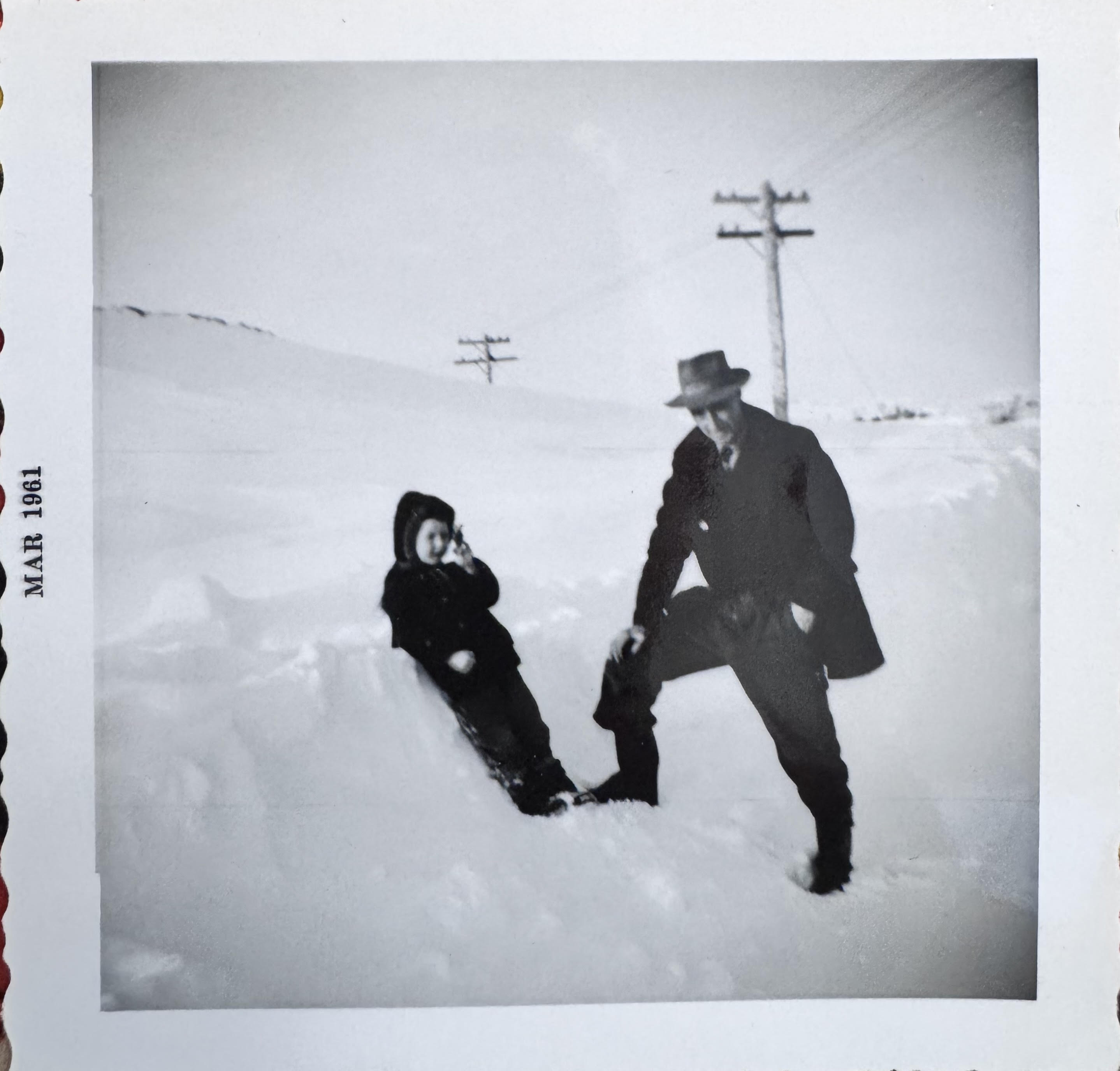
Me and dad, March 1961. Mom took this photograph. I seem to recall that we stopped on the way back to Heart’s Content from Carbonear as mom and dad were reminiscing about the halfway house being gone. Reminicences always need to be verified! In this case they seem to align with other relevant information.
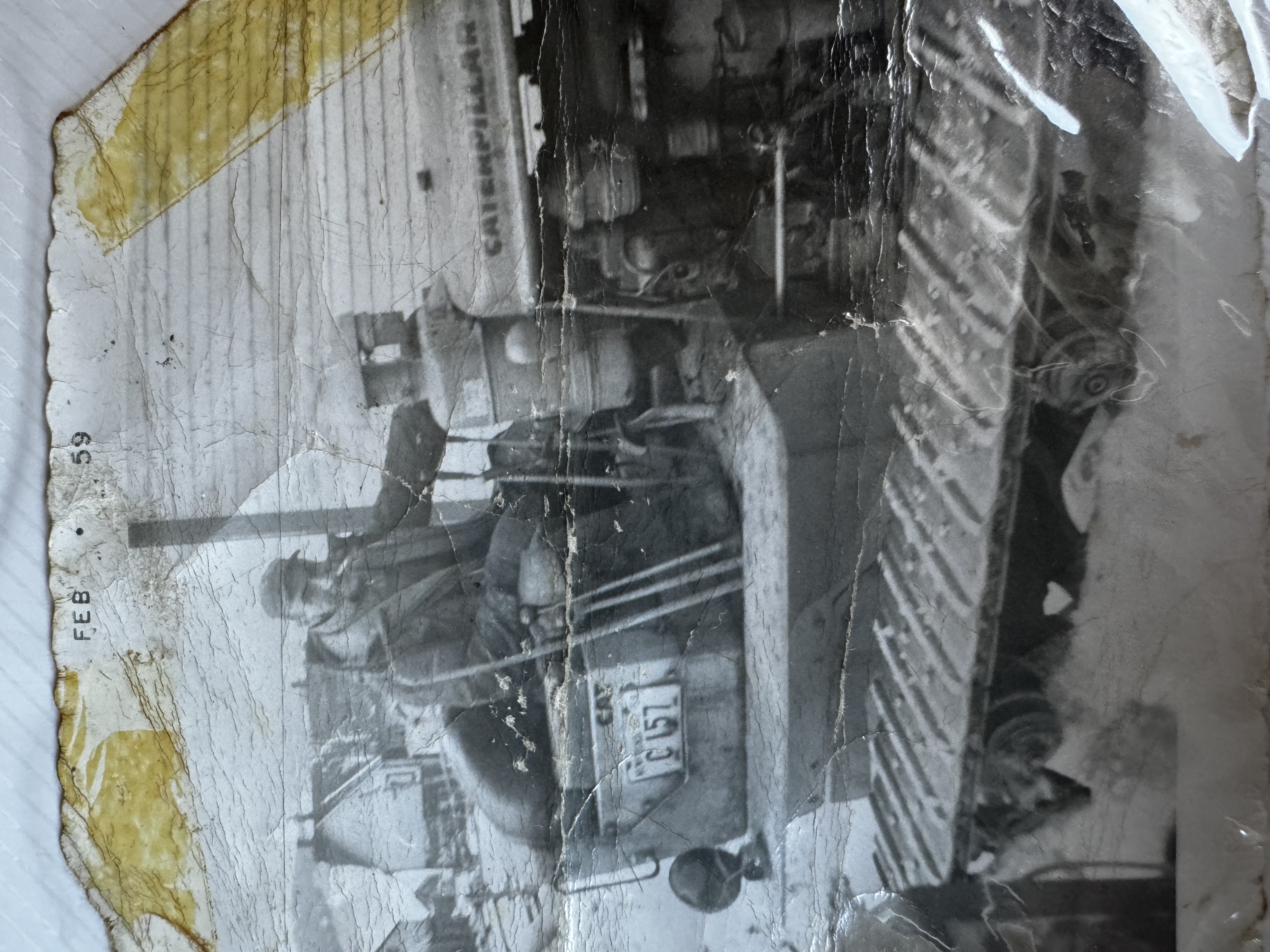
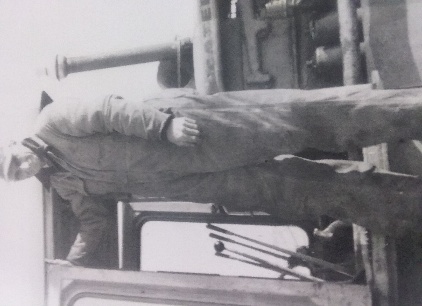
The first photo shows dad at Heart’s Content plowing snow. Notice there is no cab on the bulldozer.
Such luxury was not yet permitted! The other photo was taken sometime later. By this time the cab is on the bulldozer, and, after some “convincing”, it stayed on year-round!
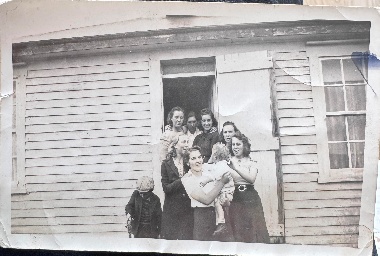
Dad wrote on the back of this photograph: “Carbonear girls 1938/39”. The baby is my brother, Frank. The lady on the left in the doorway appears to me to be my mother.
Posted by Jeff George, this photograph is captured from a Heritage Heart’s Content Facebook Page. Group speculation has the driver being the meat delivery man from Carbonear, Mr. Hogan.
Posted by Jeff George, this photograph is captured from a Heritage Heart’s Content Facebook Page. Group speculation has the driver being the meat delivery man from Carbonear, Mr. Hogan.
Dad wrote on the back of this photograph: “Carbonear girls 1938/39”. The baby is my brother, Frank. The lady on the left in the doorway appears to me to be my mother.
St. John’s Daily Mail, February 6th, 1868
The Public Ledger, February 6th, 1868
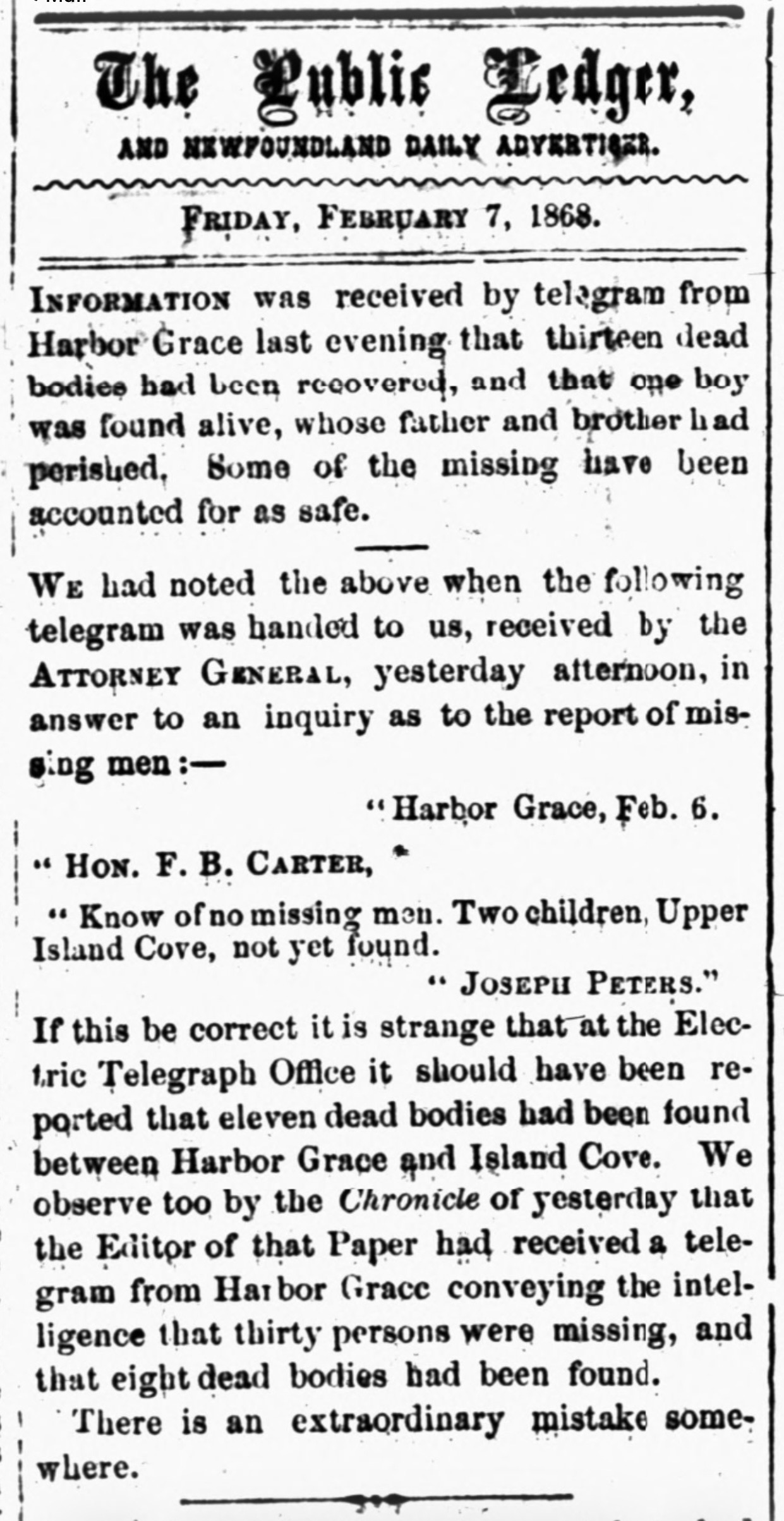
The Public Ledger, February 8th, 1868
Appendix - Faithful Dog Saves Life of Sportsman
Observer’s Weekly, “Covering the Island with Staff Correspondents -
Carbonear Notes”, October 21, 1941
Faithful Dog Saves Life of Sportsman - FAITHFUL DOG LEADS RESCUE PARTY
CARBONEAR, Oct, 14 – On Wednesday morning last five men, namely Eric Taylor, Russell Howell, Hayward Burden, Ambrose Moores, and Jack Penny went shooting on the Heart’s Content barrens. Leaving the road near the halfway house the first two named took a westerly course, the other three a northerly one. These three men were in speaking distance of each other until Penny fired at a bird that he didn’t kill outright, but which fell after flying a short distance. Penny accompanied by his dog left to pick it up and didn’t return. His two companions waited for a couple of hours and then decided he must have taken another route to the road. Arriving at the Halfway House and learning he had not been there, they returned to the barrens but couldn’t find him, so they retraced their steps, it being dark and densely foggy. Returning to town they reported Penny’s disappearance to the police. A couple of cars with a number of men proceeded to the Halfway House, and they with Mr. Wallace Richards who was staying at the house, found they could do little because of the dense fog and terrible blackness. They patrolled the road for some distance, firing guns and tooting horns in the hope that the missing man would hear them and know that help was near at hand. At 5 a.m. Thursday a large number of men left for the hand soon the surrounding barrens were covered. Search continued until 1 p.m. when those near enough to walk to the road did so reporting their morning’s travels. After lunch was served by Mrs. Ro[d]gers, assisted by Magistrate Ash and Rev. H.M. Davis, the search was renewed. At 2,30 p.m. Const. Gosse and Fred Chubbs stopped for a few minutes on the top of a small hill and surveyed the surrounding ground. Some distance away they saw what looked like a black object going around in a circle, and hoping that it was the missing man’s dog, the Constable fired a couple of shots, thinking that if he heard the shots he might bark. The plan worked for the dog came out into the open and putting his forepaws on a stump barked furiously. The Constable and Chubbs hurried to where the dog was and he led them to a clump of brushwood and there lay the missing man, in an unconscious condition. A volley of shots were fired and all the nearby searchers answered it. An improvised stretcher was made from guns, coats, windbreakers, etc., and the man carried to the Halfway House. There was no stop whatever, as soon as one bunch of men got tired, a fresh lot took the guns. A couple of men had been sent on ahead to inform the people at the Halfway House and everything was ready to receive them, and news of the finding had already been phoned to the distracted family. About 4 p.m. he was brought to his home where Dr. Stentaford and Nurse Moore attended to him.
Jack owes his life to the dog, not only did he keep him warm by lying on him and putting his paws around his neck, but he led the rescuers to his side. Even after Jack lapsed into unconsciousness the faithful animal did his best to arouse him, or else to cover him, for those who found him say that all the turf was torn up and the nearly covered. Strange to say, the dog didn’t belong to Jack, it was Captain Steve Penney’s “Rover”. However, he was a great pet with Jack and, as Mrs. Penney told your correspondent, “would perish by him rather than leave him”. Her faith in the dog was justified.
Jack is a son of Mr. and Mrs. Lockhart Penney, Hr. Rock Hill. They wish to thank all the men who formed the search party, those who lent cars, Rev. H.M. Davis for spiritual comfort and also for joining in the search, Magistrate Ash, Dr. Stentaford and Nurse Moore, and especially Const. Chubbs and Mr. Fred Chubbs who were the lucky finders.
Latest reports state that Jack is about fully recovered and was out for a short walk today. “Rover” is being hailed by everyone as a real hero and we wish he could have a medal.
Appendix - Dr George Skelton’s Ordeal on the Barrens
(From the Carbonear Star, Feb. 19, 1834)
The following is an extract of a letter to a gentleman of this town, from G. Skelton, Esq., Surgeon of Trinity Bay, … relative to his sufferings during a journey from hence to Heart’s Content. The Doctor was accompanied by an elderly person named Rowe, and two Pilots.
Heart’s Content, Feb, 14
Weather very cold, walking very bad, snow deep. As soon as we arrived on the barrens Rowe gave out. He and my two pilots wished to return, but this I would not listen to. It was with much difficulty that we got Rowe on for three miles further, he was obliged to be assisted by both pilots to get him on, so far. We were now on the highest part of the barrens, and you well know that not much shelter is to be had there. The three men were then, on account of Rowe, obliged to put up for the night, and I must say, I was very apprehensive that Rowe would die. I dreaded very much being out all night, and therefore proceeded alone, hoping to reach Heart’s Content by eight; but when I arrived at about three miles from the harbor I could proceed no further on account of the great depth of snow in the woods. It was now near sunset. I had no provisions with me nor tinder craft, these being left with the pilots. I therefore walked about upon Rocky Pond and the open country, until ten o’clock, when, as I could not get out, I retraced my steps to the place where I first made the back of the woods, and arrived there at about three o’clock in the morning. As I did not wish to lie down for fear of being injured by the frost, I trod a path of about eight yards long and walked to and fro in it until welcome daylight appeared. I then beat my steps to the westward; and, as soon as I had a good view of the harbor, which bore N.W., I attempted to get through the woods in a direct line - hoping to do it in about six hours. When I had proceeded about three-quarters of a mile (which I was obliged to do on my hands and knees) I grew very weak, and could proceed no further. It would not do to remain here. I therefore retraced my steps and arrived on the barrens by two o’clock. Seeing a pond to the westward, I went to the upper end of it, hoping to find a path that might lead me out, but there was none. When I was at the upper end of the pond, near the place where the brook makes its exit, I had the misfortune to fall in; and as the water was deep, I was near being drowned, and with great difficulty, extricated myself. Before I reach the side of the pond, which was very near, I fell in again four times, and four times succeeded in getting out. As the day was very cold, my clothes were soon stiff upon my back. I now thought it would be best to lie down and die; but, as I had some strength remaining I considered this would not be right. I had no doubt but that search would be made for me the next morning - but how was I to live the night. I now determined that I would attempt to get back to Carbonear, and with great difficulty proceeded for about two miles and a half in that direction - although I had no hope of reaching the place. I was by this time completely exhausted, determined to lie down and die, and I chose a place for that purpose - I thought I would make a signal where my body would be found - stuck my walking stick into the snow with that intention - was on the point of trying my pocket handkerchief upon it as a signal, when, in that vert instant, I heard the report of a gun and
immediately after the report of a second one. As I could not hear in what direction the guns were fired and as the country towards Heart’s Content was open, I proceeded up the hill towards Carbonear. I did not however, fail to look behind me, when, in a short time, I had the happiness of seeing three or four men at about three-quarters of a mile off - and at the same time heard many voices. I now put my hat upon my walking stick, held it up as a signal and the men soon saw it. As they advanced towards me, and I toward them, we met in about ten minutes and in a short time were joined by more men, to the number of twenty at least. As the men had brought with them some refreshments, of which I partook, I was in a short time so far revived as to be enabled, with the assistance of two men at a time, to walk to Heart’s Content, where my friend, Mr. Aldridge, had provided everything comfortable for me.”
The Star adds: “The middle finger of the Doctor’s right hand was severely frostbite-bitten. - The Doctor is an elderly man, and it appears quite miraculous he should have escaped with so little injury”.
Blank Page
Internet query, precise source unknown for this research.↩︎
There were more halfway houses, and in other areas, perhaps formal government-sanctioned structures or more
simple locally constructed shelters. One example is the halfway house at Trinity Bight between Port Rexton and
Melrose.↩︎Internet query, precise source unknown for this research.↩︎
Lisa Wilson, “Winter of the Barrens”, Newfoundland Folkways, March 6, 2014,
https://newfoundlandfolkways-blog1.tumblr.com/post/78764476637/winter-on-the-barrens-after-visiting-hearts↩︎Frank E. Clarke, “Victoria: A Brief History”, posted on Newfoundland’s Grand Banks genealogical site (NGB),
http://ngb.chebucto.org/Articles/victoria-hist.shtml↩︎Ted Rowe, Heroes & Rogues: and the Story of Heart’s Content, Creative Publishers, St. John’s, 2011, digital
version, pp. 80 – 82.↩︎Levi Curtis (Reverend), “The Methodist (now United) Church in Newfoundland”, from The Book of Newfoundland,
Volume II, Edited by Joseph R. Smallwood, 1937, pp. 288 – 295 of the 1979 reprinting, specific reference, p. 293.↩︎Frank E. Clarke, “Victoria: A Brief History”.↩︎
Ted Rowe, Heroes & Rogues, p.86.↩︎
Melvin Rowe, I have Touched the Greatest Ship, Town Crier Publishing Company, St. John’s, 1976, pp. 94,95.↩︎
Frank E. Clarke, “Victoria: A Brief History”.↩︎
As per The St. John’s Daily News, February 19, 1861, p.2.↩︎
Frank E. Clarke, “VICTORIA HISTORY - TRAGEDIES ON THE BARRENS, PART III – NOTES”,↩︎
"Coombs Day" (traditionally February 3rd) is an old regional term from Newfoundland and Labrador that
historically refers to a particularly violent and savage winter snowstorm.↩︎Upper Island Cove Family Roots, “Coombs Day and Stormy Weather”, transcribed by Randell Mercer on Dec 18,
2020, from an article written by Don Morris, which may have been previously published in The Compass.
Sources for statements in the article are not provided. See https://www.upperislandcovefamilyroots.site↩︎Ibid.↩︎
Harry M. Mosdell, When Was That? A Chronological Dictionary of Important Events in Newfoundland, 1923,
page 119 (127 of the digital version), https://collections.mun.ca/digital/collection/cns_tools/id/21019/↩︎Melvin Rowe, I Have Touched the Greatest Ship, p. 82.↩︎
Also recounting this story, Frank E. Clark seems to have mistyped the year as 1886.↩︎
Ted Rowe, Heroes & Rogues, p. 121.↩︎
Melvin Rowe, I Have Touched the Greatest Ship, p. 80.↩︎
Ibid., p. 81.↩︎
Ibid.↩︎
Not to be confused with the “Gunnar’s” Rock landmark from a famous Islandic saga, the precise location of
Gunner’s Rock in reference to Heart’s Content Barrens may be lost to time. One story goes that when the mail
man reached a certain rock on his way to Heart's Content with the mail, he would fire off his gun announcing
the soon arrival of the mail. Hence the name Gunner's Rock. From this, one would think it wasn't too far from
Heart's Content. Notwithstanding the waste of ammunition, Jashua Green’s account (see above) seems to put
the rock further away. Perhaps somewhere closer to and North of the fourth bridge.↩︎Frank E. Clarke, “Victoria: A Brief History”, speculates that the Victoria end of the road may have been further
south from its present location, perhaps closer to Job’s Pond.↩︎Melvin Rowe, I Have Touched the Greatest Ship, p. 81.↩︎
Ted Rowe Heroes & Rogues, p. 84, referencing The Star and Conception Bay Journal for September 21, 1836.↩︎
Melvin Rowe, I Have Touched the Greatest Ship, p. 81.↩︎
Ted Rowe, Heroes & Rogues, p. 84.↩︎
Identified by Melvin Rowe and others, the letter was published in the Wednesday, June 6, 1838, issue of
The Star and Conception Bay Journal.↩︎Ted Rowe, Heroes & Rogues, p. 85.↩︎
Ted Rowe, Heroes & Rogues, p.121, identifies the source as Arnold Pitcher and the house as it appeared c 1900.↩︎
Memorial University of Newfoundland - Digital Archives Initiative, “Journal of the House of Assembly of
Newfoundland 1871”, Appendix, Page 203, [showing] Board of Works, Detailed Statement of Expenditures, By
the Board of Works on account of Road from Carbonear to Perlican, for the Year ended 31st Dec., 1870.↩︎Ted Rowe, Connecting the Continents – Heart’s Content and the Atlantic Cable, Creative Publishers, 2009, p. 50.
Rowe references the Anglo-American Telegraph Company (AATC) Letter Book, Weedon to Collett, October 26,
1869. Also, personal email correspondence from September 16, 2026.↩︎As per The St. John’s Daily News, February 19, 1861, p.2.↩︎
Personal email correspondence with Bert Parsons of Carbonear, September 26, 2026, referencing The Harbour
Grace Standard, March 19, 1873.↩︎Ibid.↩︎
Ibid.↩︎
The St. John’s Daily Star for June 16, 1920.↩︎
Following previous construction at Victoria in 1904, this now allowed electricity and telephone connection from
Victoria with the towns of Heart’s Content, Carbonear, and Harbour Grace. See Ted Rowe, Connecting the
Continents, 2009, p. 123.↩︎The St. John’s Daily Star for September 22, 1920.↩︎
Frank E. Clarke, “Victoria: A Brief History”.↩︎
A halfway house at Salmonier was established by 1866, before that at Heart’s Content. Its’s keeper was initially
paid slightly more, $162 per annum. See “Laws of Her Majesty’s Province of Newfoundland”, Queen’s Printer,
1866, bnald.lib.unb.ca, NL_1866_cap 22_edited.pdf, https://share.google/aLqsH3k1BbXocNmGF↩︎See the Public Service Act, 1905, p. 204, https://collections.mun.ca/digital/collection/statutesnl/id/11509/rec/6↩︎
Lloyd Wagner, Decks Awash, vol. 18, no. 02 (March - April, 1989), p. 61.↩︎
Beginning, “Oct. 14 - On Wednesday morning last”, suggests that the event took place on October 8th.↩︎